
A life lived with courage, creativity, and unwavering purpose.
There are some people who move through the world quietly, careful not to raise attention.
And then, there’s Lynn.
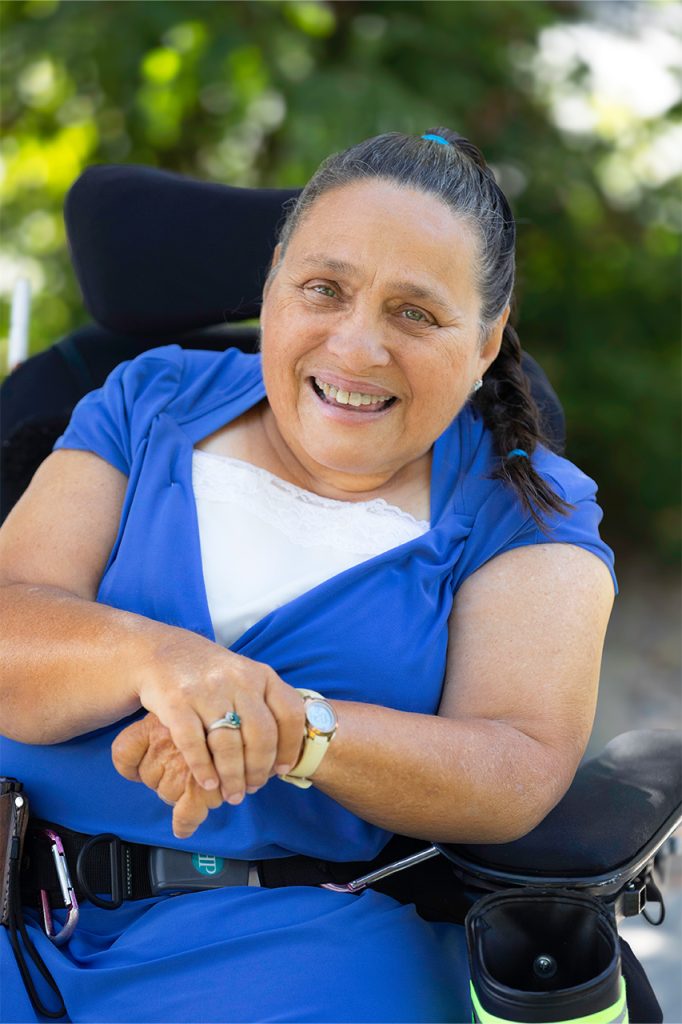
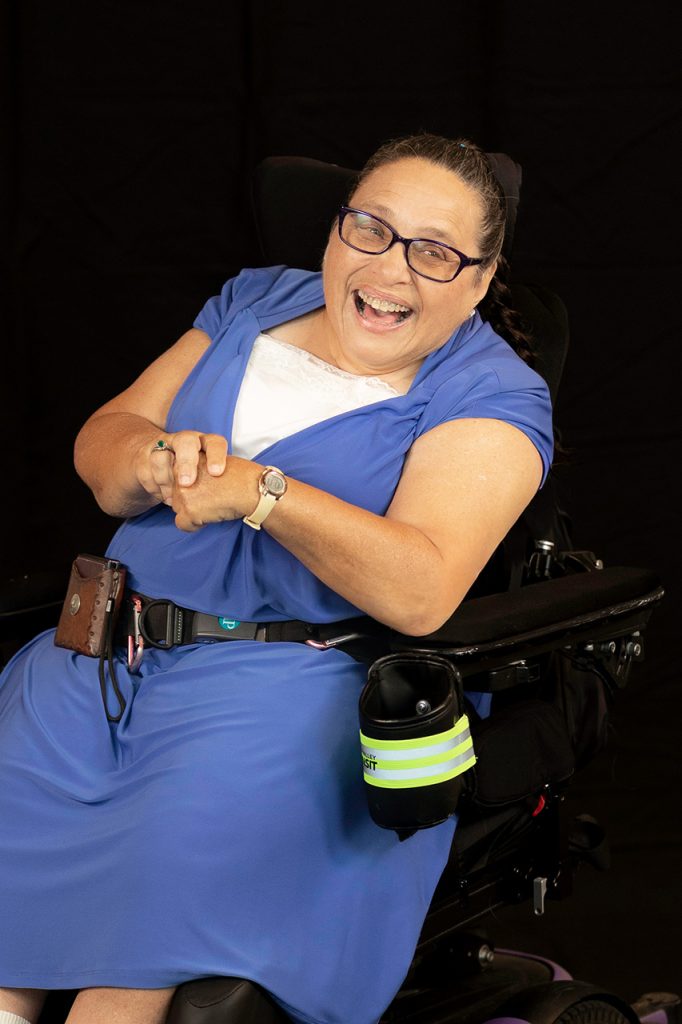
Lynn is quick with a story and even quicker with a smile. As she shares her lived experiences, it becomes clear after only a few minutes: Lynn moves through the world with conviction and is not someone who waits for life to happen.
Lynn has cerebral palsy and is quadriplegic with limited mobility in one arm. Her life has been shaped by discriminatory systems and by the choices she’s made, again and again, to challenge the status quo and keep going despite the barriers.
She’s done that not only for herself, but for others, too. Through advocacy, volunteering, and service, Lynn has built a life centered on helping people find access, independence, and support.
I like to paint peaceful things, because our world is not peaceful.
The paintings that adorn the walls in Lynn’s home — watercolor and acrylic landscapes, flowers, and animals — reflect the peace that Lynn seeks when life gets too loud. Painting is more than a hobby; it’s a quiet space that brings her calm in a life that has required constant planning, persistence, and problem-solving.
“I like to paint animals. I like to paint flowers. I like to paint peaceful things,” she says. “Because our world is not peaceful.”
It wasn’t an interruption. It WAS my life.
Lynn’s love for art began as a child. Between the ages of 3 ½ and 16, she underwent 12 surgeries. For long stretches of time, she was in the hospital more than she was at home. For Lynn, that medical care wasn’t something that occasionally disrupted childhood; it actually was childhood.
What Lynn remembers from those years isn’t just the hard parts, though — it’s how the volunteers showed up to create art, read stories, play games, and help with homework. That early experience taught Lynn that community support is more than a kindness; it’s a necessity.
You’re going to tell me no? Watch out, because I don’t do ‘no’.
Transcript
“You know, it doesn’t matter how God made us. We all deserve to have a fulfilling life and be able to do the things we want to do. And I’m an example of, ‘You’re going to tell me no? Well, watch out, because I don’t do No.'”
Lynn left home for college in Oregon at 19. Her independence required caretakers and thoughtful housing planning, but she pursued her dream of becoming a school librarian. Throughout high school and college, she spent her volunteer hours in libraries. But by the time she graduated with her bachelor’s degree in elementary education, the school she’d planned to attend for her master’s in library sciences had closed — and no other schools she was accepted to were the right fit.
She changed courses, pursuing opportunities in education. But in the 1980s, before the Americans with Disabilities Act was passed, discrimination was ever-present in education and employment, and Lynn was unable to complete the student-teaching requirements to obtain her license to teach in public schools.
So Lynn again adapted. Her grandmother lived in Grand Junction, Colorado, and shared stories about a local special education teacher with physical disabilities. Lynn hadn’t met the woman but was inspired nonetheless. Soon after, Lynn moved to Grand Junction and began rebuilding her life. She lived in an apartment before later moving into her grandmother’s home — the same home she lives in today.
She began working in faith-based schools that didn’t require a public teaching license at the time. In many ways, she loved it, but she also experienced what it means to work in environments that are not designed to accommodate people with disabilities. An incident occurred on an inaccessible second-story floor, and Lynn was unable to respond to it herself. The system was unprepared, and Lynn realized at that point it was time to step away from education.
I don’t know any different. This is how I am.
Lynn was no stranger to advocacy, participating in protests and sit-ins as she joined others in challenging discriminatory policies and making her voice heard throughout her life. She had become familiar with the Center for Independence (CFI) as a consumer, receiving equipment support and assistive technology, and she reconnected with the organization after leaving her teaching career.
Over several decades, Lynn remained deeply committed to the CFI. Although circumstances changed — such as when she moved back to Oregon for a few years after her grandmother passed away, or wage policy changes threatened her ability to retain the disability services she needed to live — she always returned, holding various roles as a volunteer, an independent living specialist, a case manager helping others navigate and access disability benefits, and a board member.
This is wrong. Fix it.
Lynn’s personal life has been shaped by discriminatory policy, too.
She and her partner, Richard, have had to make decisions no couple should ever have to make. Their relationship has endured over time, across distance, and through systems that made building a conventional life difficult.
Lynn and Richard married and lived together in Oregon, but disability benefits rules created a barrier to their marriage and cohabitation. Their combined income was too much to retain the benefits they needed, and a few short years later, they legally separated before being forced into an unwanted divorce to preserve access to these services. It was a decision that disrupted their lives and challenged their deeply held religious convictions. Lynn even approached her church’s pastor with the plea to “fix it” — to fix their “paperwork divorce” and provide them with a blessing.
We all deserve to have a fulfilling life.
Today, Lynn and Richard both live in Grand Junction. They remain unmarried and live in separate households — despite their love for one another — to maintain their benefit eligibility. Lynn is clear about what that kind of policy does: It doesn’t change commitment, but it changes the shape of a life.
Through it all, Lynn keeps going. She’s found a home with CFI, where she can help others do what she’s spent her life doing — building access, independence, and a life. She volunteers and remains deeply involved in her church. She also serves as her mother’s medical and legal power of attorney, helping coordinate care and make decisions as her mother’s needs increase.
“I advocate,” she says, “and I will probably advocate until the Lord takes me home, because we have to be able to function. All of us… all the people everywhere, no matter what the disability is. It doesn’t matter how God made us; we all deserve to have a fulfilling life and be able to do the things we want to do.”
And through every choice to speak up, push back, and advocate, Lynn paints a picture of what dignity and possibility should look like for everyone.